Seis países representan el 40% de la superficie terrestre del planeta, liderados por Rusia
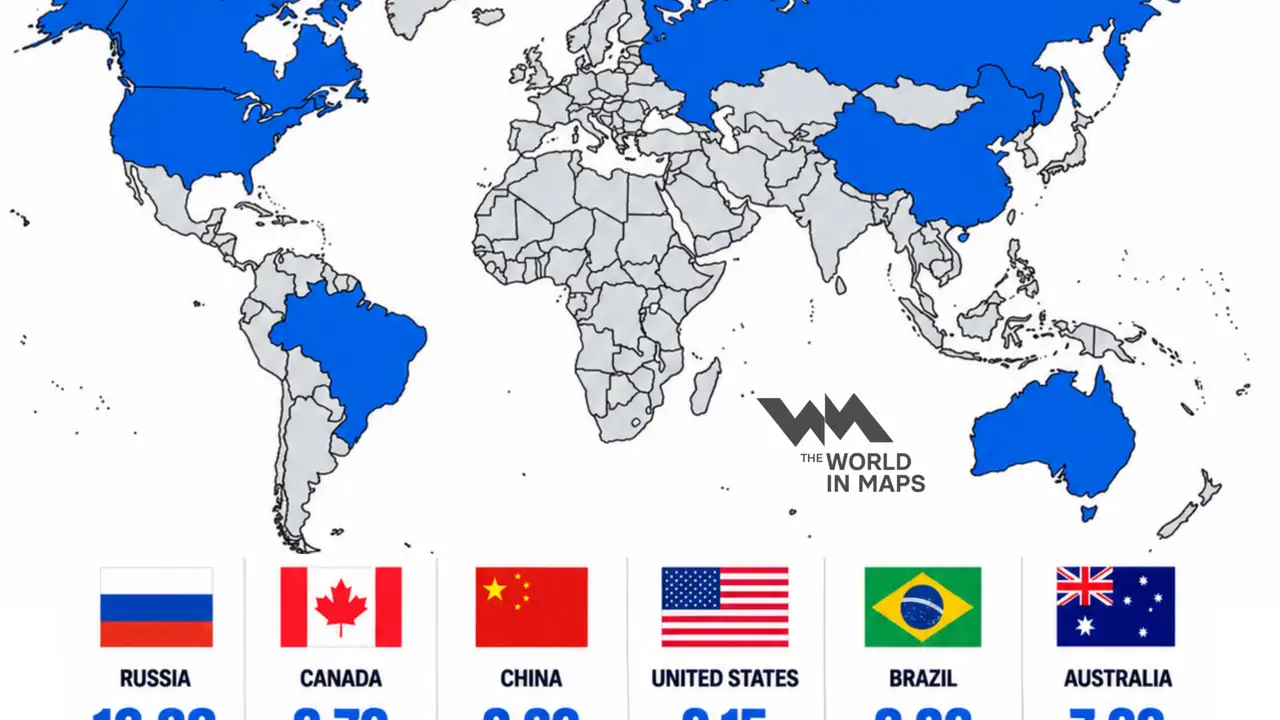
Six countries account for 40% of Earth's land area, led by Russia
Just six countries — Russia, China, the United States, Canada, Brazil and Australia — cover about 40% of the world's land area, highlighting how much of the planet is concentrated within a handful of national borders.

According to figures presented by World Visualized, the six countries occupy a combined 59.75 million square kilometres, compared with an estimated 148.94 million square kilometres of land worldwide.

Russia leads with approximately 16.38 million square kilometres of land, making it the world's largest country by a considerable margin.

China follows with 9.39 million square kilometres, ahead of the United States at 9.15 million and Canada at 8.79 million. Brazil covers approximately 8.36 million square kilometres, while Australia accounts for 7.69 million.

Together, these countries stretch across five continents and include some of the world's largest forests, deserts, agricultural regions and mineral reserves.

The figures measure land area rather than total territory, meaning inland waters are excluded. This distinction helps explain why Canada, often ranked as the world's second-largest country by total area, falls behind China and the United States when only land is counted.

The six countries also account for a substantial share of the world's population, with China and the United States among the most populous.

The World Bank's 2024 land-area figures confirm the six-country ranking, showing that geographical size remains heavily concentrated even though the world's population is spread across many more countries. 
Data

Three main points
1. Six countries cover about 40% of Earth's land.
2. Russia leads with 16.38 million square kilometres.
3. China ranks second, followed by the US and Canada.
Six countries account for 40% of Earth's land area, led by Russia Just six countries — Russia, China, the United States, Canada, Brazil and Australia — cover about 40% of the world's land area, highlighting how much of the planet is concentrated within a handful of national borders. According to figures presented by World Visualized, the six countries occupy a combined 59.75 million square kilometres, compared with an estimated 148.94 million square kilometres of land worldwide. Russia leads with approximately 16.38 million square kilometres of land, making it the world's largest country by a considerable margin. China follows with 9.39 million square kilometres, ahead of the United States at 9.15 million and Canada at 8.79 million. Brazil covers approximately 8.36 million square kilometres, while Australia accounts for 7.69 million. Together, these countries stretch across five continents and include some of the world's largest forests, deserts, agricultural regions and mineral reserves. The figures measure land area rather than total territory, meaning inland waters are excluded. This distinction helps explain why Canada, often ranked as the world's second-largest country by total area, falls behind China and the United States when only land is counted. The six countries also account for a substantial share of the world's population, with China and the United States among the most populous. The World Bank's 2024 land-area figures confirm the six-country ranking, showing that geographical size remains heavily concentrated even though the world's population is spread across many more countries. Data Three main points 1. Six countries cover about 40% of Earth's land. 2. Russia leads with 16.38 million square kilometres. 3. China ranks second, followed by the US and Canada.
Source: Six countries account for 40% of Earth's land area, led by Russia Just six countries — Russia, China, the United States, Canada, Brazil and Australia — cover about 40% of the world's land area, highlighting how much of the planet is concentrated within a handful of national borders. According to figures presented by World Visualized, the six countries occupy a combined 59.75 million square kilometres, compared with an estimated 148.94 million square kilometres of land worldwide. Russia leads with approximately 16.38 million square kilometres of land, making it the world's largest country by a considerable margin. China follows with 9.39 million square kilometres, ahead of the United States at 9.15 million and Canada at 8.79 million. Brazil covers approximately 8.36 million square kilometres, while Australia accounts for 7.69 million. Together, these countries stretch across five continents and include some of the world's largest forests, deserts, agricultural regions and mineral reserves. The figures measure land area rather than total territory, meaning inland waters are excluded. This distinction helps explain why Canada, often ranked as the world's second-largest country by total area, falls behind China and the United States when only land is counted. The six countries also account for a substantial share of the world's population, with China and the United States among the most populous. The World Bank's 2024 land-area figures confirm the six-country ranking, showing that geographical size remains heavily concentrated even though the world's population is spread across many more countries. Data Three main points 1. Six countries cover about 40% of Earth's land. 2. Russia leads with 16.38 million square kilometres. 3. China ranks second, followed by the US and Canada.

Solo seis países, Rusia, China, Estados Unidos, Canadá, Brasil y Australia, cubren alrededor del 40% de la superficie terrestre del mundo, lo que destaca cuánto del planeta está concentrado dentro de un puñado de fronteras nacionales.

Según las cifras presentadas por World Visualized, los seis países ocupan conjuntamente 59,75 millones de kilómetros cuadrados, frente a una estimación de 148,94 millones de kilómetros cuadrados de tierra en todo el mundo.

Rusia lidera con aproximadamente 16,38 millones de kilómetros cuadrados de tierra, lo que la convierte en el país más grande del mundo por un margen considerable.

China sigue con 9,39 millones de kilómetros cuadrados, por delante de Estados Unidos con 9,15 millones y Canadá con 8,79 millones. Brasil cubre aproximadamente 8,36 millones de kilómetros cuadrados, mientras que Australia representa 7,69 millones.

RECOMMENDED FOR YOU
America’s favourite Thanksgiving side dishes in 2026

los acompañamientos favoritos de Acción de Gracias en Estados Unidos en 2026

Juntos, estos países se extienden por cinco continentes e incluyen algunos de los bosques, desiertos, regiones agrícolas y reservas minerales más grandes del mundo.

Las cifras miden el área de tierra en lugar del territorio total, lo que significa que se excluyen las aguas interiores. Esta distinción ayuda a explicar por qué Canadá, a menudo clasificado como el segundo país más grande del mundo por área total, queda por detrás de China y de Estados Unidos cuando solo se cuenta la tierra.

Los seis países también representan una parte considerable de la población mundial, con China y Estados Unidos entre los más poblados.

Las cifras de superficie terrestre del Banco Mundial de 2024 confirman la clasificación de seis países, mostrando que el tamaño geográfico sigue estando muy concentrado aunque la población mundial esté distribuida entre muchos más países.

Datos

Tres puntos principales

  1. Seis países cubren alrededor del 40% de la superficie terrestre.
  2. Rusia lidera con 16,38 millones de kilómetros cuadrados.
  3. China ocupa el segundo lugar, seguida por EE. UU. y Canadá.

This story is written and edited by the Global South World team, you can contact us here.